KineticSketch
KineticSketch

Dossier
cogneeBandNimble
MEETUPCompleted
Fri, Nov 13, 2026
See what happens when builders get in a room. Explore the projects, watch the demos, and meet the people behind them.
// Built at this event
Explore what the builders made. Watch a demo, meet the team, and dig into the code.
Dossier
Lights Out is a software factory in one Band Desktop room, named for the lights-out factory, the manufacturing term for a plant that runs with nobody on the floor: a foreman, a builder and three seats that check the work on their own. The verifier seals its acceptance tests before any code exists. The second-reader, on another model family, numbers every sentence of the specification and must show evidence for each. The product-user walks every screen in a browser. A program closes a stage only when all three pass the same commit. From one human message the band built all four Dossier stages in 419 minutes, each accepted by our own gate. Team: Zeyu Sun (solo). Track: Dossier. Repository: (start with README.md and docs/FACTORY.md).
Three agents, two human messages, and a reviewer that locks its tests before the code exists. Note : I attended the kickoff in person and would love to be considered for the specific prize track for the same as well. Sealed Factory is a three-seat AI software factory in Band Desktop. A Lead, a Builder and a Reviewer take a written spec and deliver a containerised, tested service with no human input after the dispatch. It built Dossier, a company research service that returns facts about a company, each backed by quoted evidence. Why it stands out: --> Tests sealed before the code : The Reviewer writes its own test plan from the spec and posts its SHA-256 fingerprint before any code exists, then publishes the plan at the end. The review is provably independent. --> Review that changed the work : Seven rejections, each for a real defect and each fixed, several of them while the shipped checks were already fully green. --> No human in the loop : Two human messages in total: one dispatch for stage 1 and one for stages 2 to 4. No hints, approvals or reruns. The submitted run was the factory's first run. --> Work shared across seats, 57 commits: Builder 25, Reviewer 22, Lead 10. No history rewritten. --> A reusable factory. The whole factory is three mandate files that name nothing about the product. They pass the event's generic-mandate check. How far it got : --> All four stages pass the shipped checks in order, each in its own frozen folder. Where Band is used : --> One Band Desktop room holds the entire run: every handoff, verdict and rejection is a direct message between seats. --> Each handoff carries the full task and spec, because a seat only sees messages addressed to it. --> The three seats share one workspace and one Git repository, so every commit traces back to a room message. --> The room log is the evidence: it is committed unedited as room.json. Where Nimble is used --> Nimble is the service's only required research provider, called through WebRouter. --> Each company build runs a Nimble research run and Nimble searches in parallel, then reads the pages they point to with Nimble extract. --> Every quoted excerpt comes from a page Nimble actually served; nothing is invented or paraphrased. Each build stays inside a fixed 80-unit budget. --> On the live web, the stage 1 service researched runway.com and returned five of six fields with three excerpts each. --> In stage 4 the agents measured their own research cost on sample data and cut it from 10.6 to 5.4 units per correct field.
A three-seat BAND software factory built a four-stage, containerized company-research service. A Codex Lead delegated work and controlled stage transitions; an OpenCode Implementer built, tested and repaired the service; a Claude Reviewer independently inspected frozen commits, created adversarial probes and withheld approval until defects were closed.
Measured Factory is a four-seat software factory in Band Desktop that built the Dossier track stage by stage, with one dispatch per stage and no human input in between. How it works - The coordinator turns each stage spec into a numbered ledger of every testable requirement before any code is written, including the ones the shipped checks never test. - At the same time the examiner reads the spec blind (no ledger, no code) and writes its own list. The two lists are merged, and anything the ledger missed becomes new work. Over stages 1-3 the blind reading added 16 requirements. - Work is split into small numbered items between two builders who never edit the same file at once. Every commit names the ledger rows it covers, so each line of code traces back to a requirement and to the room message that assigned it. - The examiner reviews items as they land, using probes written from the spec only, and gives the final verdict after an isolated-mode check. - Research cost is measured, not guessed: builders compare Nimble strategies (search, extract, research) on cost per correct fact before one is chosen. Results, the timings, what it cost and everything that went wrong are in FACTORY.md. Room logs for every stage are in the repo.
The human is a capybara napping in a hot spring. Six agents in one BAND room turn a written spec into working software. Two ideas make it a dark factory you can trust: A sealed exam. The Examiner writes hidden acceptance scenarios from the spec and posts only their SHA-256. Builders never see the scenarios: BAND delivers a message only to the agents it mentions, and the exam lives on the Examiner's own disk. When a stage fails, builders see what a user would notice, never the test. Nobody grades their own homework. Ask the web, not the human. Every factual question goes to Scout, which answers from the live web with Nimble, citing a source and a confidence grade for each claim. Only a low-confidence answer reaches the human, and even that waits for the one wake-up. Nap Guard is the only agent allowed to wake the human. It wakes them once, to ask "ship or hold?" (plus a chill break if work starts thrashing). The run ends with a receipt that counts how many times the capybara was woken.
Tagline: Five AI seats that plan, research, verify, budget and remember, building Dossier, a cited company research service. Project Description: Verifier Factory is a five seat software factory built in Band Desktop. Each seat is a separate coding agent with its own generic mandate: a Planner that coordinates and hands off, a Researcher that gathers evidence, a Verifier that independently checks every result and can reject work, a Budget Keeper that holds one shared allowance for the whole run, and a Historian that keeps the record of what was decided and when. The factory builds Dossier, a company research service. Give it a company domain and it returns the facts a diligence check needs, legal name, headquarters, CEO, founding year, headcount range and funding, each with the source excerpt that supports it. In development runs on Nov 13 the factory proved its gates end to end: the seats exchanged handoffs in both directions, the Verifier rejected work at preflight and the rejection changed what the team did next, the Budget Keeper held the run inside its stated allowance, and the team built and served a working service that was verified from outside the room. In the submitted run the factory completed its Stage 1 research phase, a full WebRouter review written to the repo records, before the run paused on a provider account limit. The factory, its mandates and its records are the submission; the staged build continues to the Nov 20 deadline. Summary: A five seat AI software factory in Band Desktop building Dossier, a cited company research service, with independent verification and a shared budget on every run. AI Disclosure: This project was built with AI coding agents working as a team inside Band Desktop. A human set up the factory, wrote the seat mandates and dispatched each stage. All product code in the run repositories was written by the agent seats in the Band rooms, and the room logs are included as proof of process. Building process: The factory was designed seat first: five generic mandates that name a harness and a model and describe judgment, not product details, so the same factory can build other products. Development runs ran against a small practice service first, which caught two real failure modes (a seat reaching for a GUI tool that waits on a human, and shell approvals parking turns) before the submitted run started. The submitted run used a fresh room and a fresh repository, with each stage dispatched as a single task and no human steering after dispatch. Tags: ai-agents, software-factory, band, research, verification, multi-agent
Recorded talks, technical context, and the workflow behind real product work.
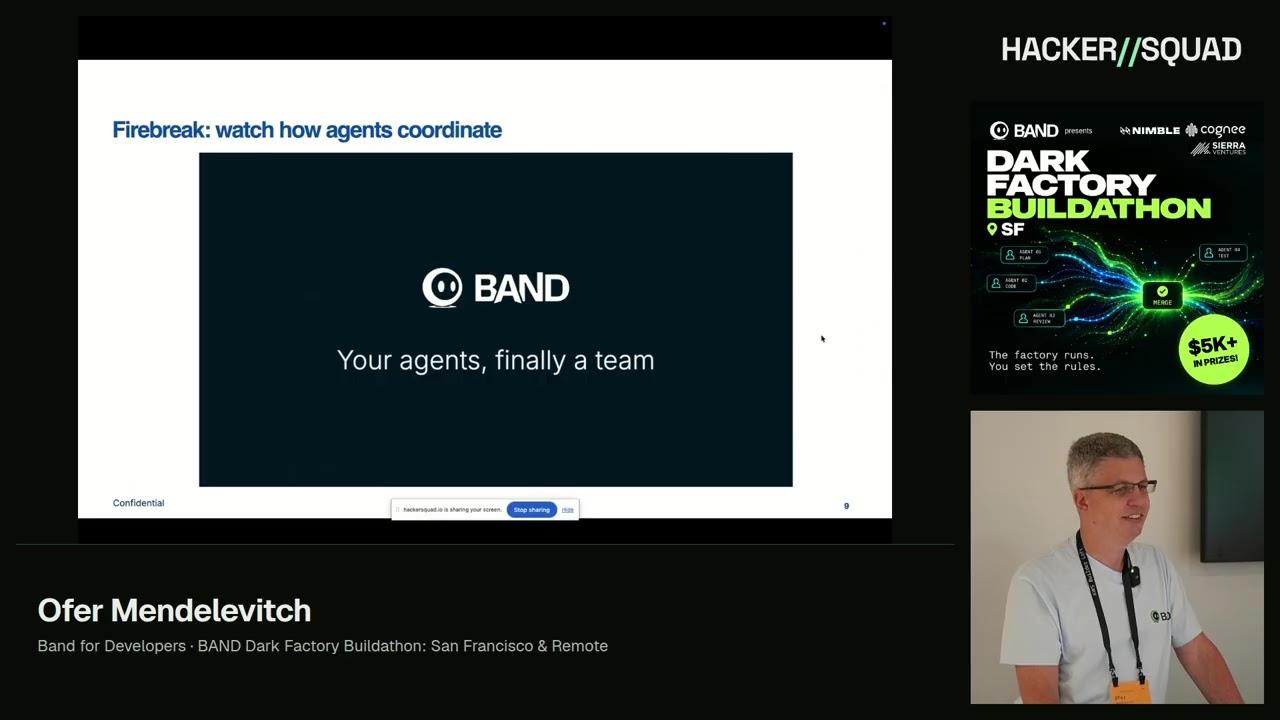 RECORDED · TALK 01

Head of Developer Relations · Band
 RECORDED · TALK 02

Head of FDE · cognee
 RECORDED · TALK 03

GTM AI Engineer · Nimble
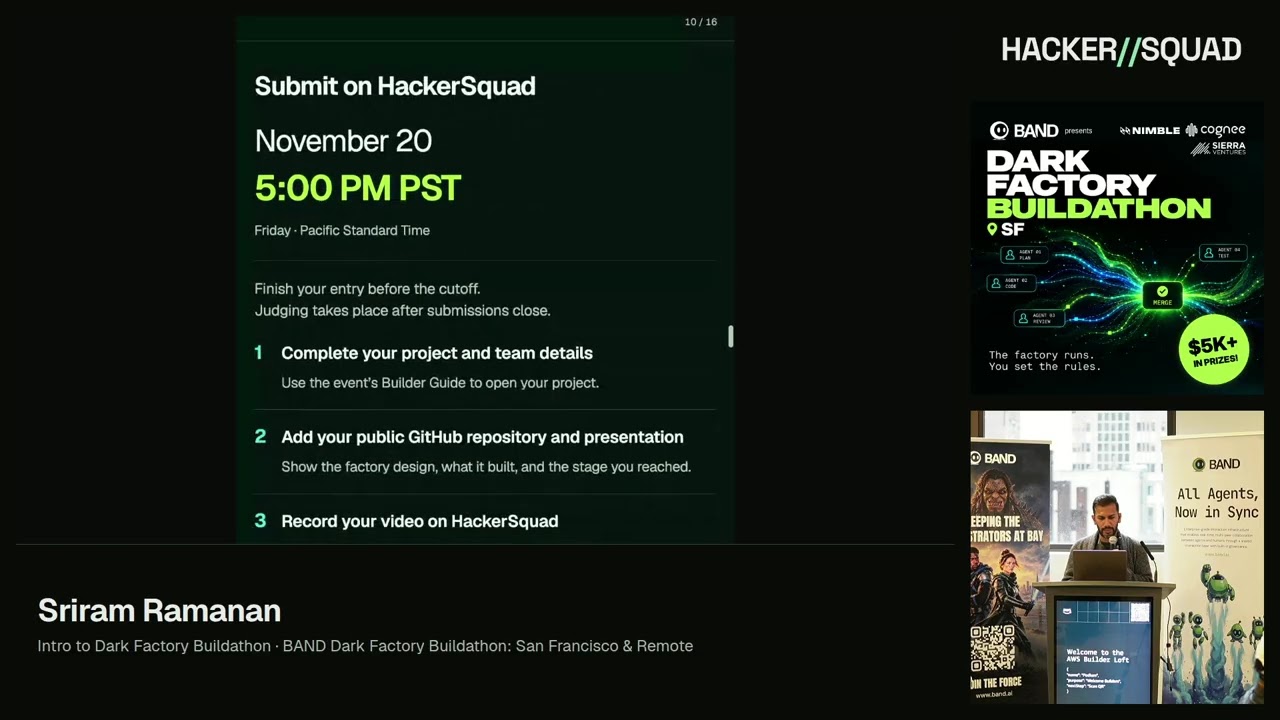 RECORDED · TALK 04




Best use of Nimble - 2nd place
Second place - best AI software factory with Band Desktop
First place - Best AI software factory with Band Desktop
Third place - best AI software factory with Band Desktop
Best use of Nimble - 1st place
Don't miss out on future events. Sign up to stay updated on upcoming hackathons and meetups.

